
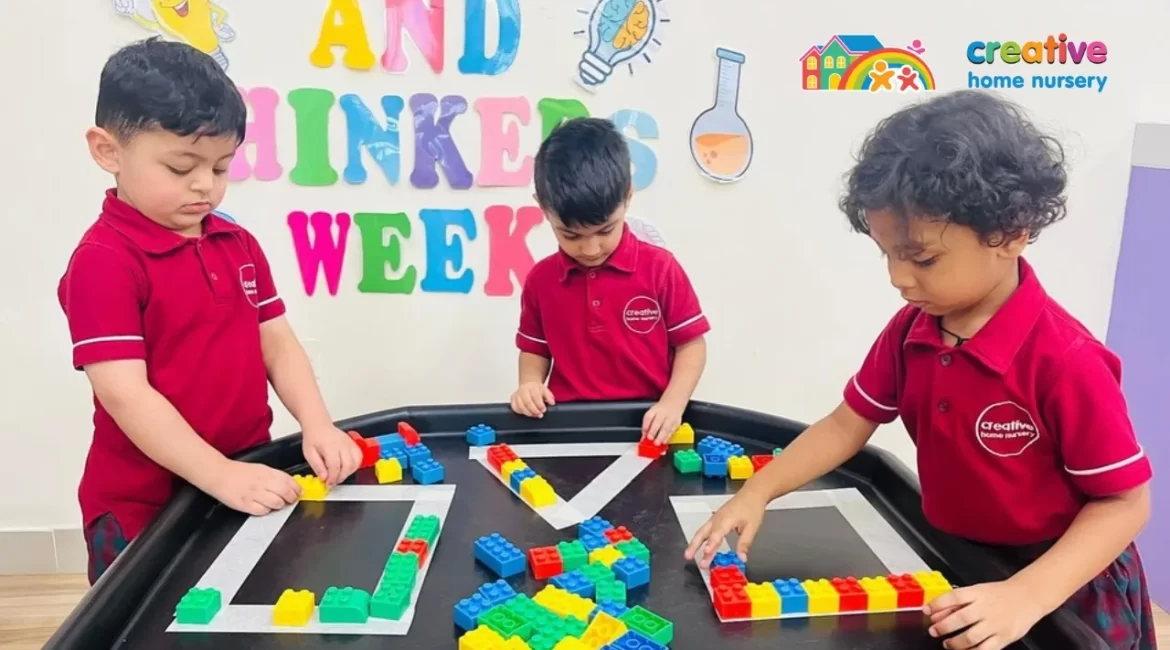
Each parent finds satisfaction in their child’s gleeful expressions of triumph upon retrieving a toy from a shelf creatively at the age of four as well as building a block tower at the age of three. These feats, while appearing simplistic, require much more. These feats demonstrate active problem solving skills development, from which the child will gain life-long benefits.
Like any other skill, problem solving does not emerge from a singular event. Instead, it comes from a building block of unique experiences, a lot of exploration, and the most important play. While parents are busy looking for the best nurseries in Sharjah and a trusted preschool in Sharjah, knowing the value of preschoolers’ critical thinking skills in a play-based learning environment will shape their decisions regarding their child’s education.
What Are the Problem Solving Skills?
The problem solving skills of a child can be articulated as the challenge to identify the task; a child needs to be able to think of a solution to the task at hand and then devise a plan to tackle the task.
For preschoolers, problem solving ability may be demonstrated through several tasks. These include:
Ascertaining how the various pieces of a puzzle interrelate
Controlling who is allowed access to certain toys during a given period
Determining how to build a tower so that it does not topple over
These cognitive skills are advantageous to children well beyond the preschool years. Proficient problem solving skills cultivated during early years foster academic achievement, bolster self-esteem, and enable sophisticated social engagement. Developed at an early age, these skills form the foundation for logical reasoning, creativity, and resilience.
Playful Activities That Foster Development of Problem Solving Skills
Construction and Building Activities
Construction toys such as blocks and Legos are filled with endless opportunities and challenges for problem solving. While children build their structures, they need to consider size, balance, and spatial relationships. If their tower topples over, they devise new strategies to manage to successfully rebuild their tower.
Puzzles and Shape Sorting
Age-appropriate puzzles help children analyze patterns, match and sort, as well as think systematically and logically. Start with simple wooden puzzles and progress to more advanced jigsaw puzzles as their skills develop.
Dramatic Play Scenarios
Dramatic play scenarios pose challenges to be addressed. “Cooking” in play kitchens or working at a pretend store sparks children’s problem solving and decision making creativity and deep imagination.
Sand and Water Play
These activities allow children to work with volumetric measurements and the flow of materials and observe cause and effect. A child discovering different types of containers or ways to construct a sandcastle that will not crumble (engineered sandcastle) demonstrates different ways of problem solving.
Art and Craft Projects
Planning, selection of materials and colors, and making adjustments along the way characterizes thoughtful and creative problem solving. These activities are open-ended and foster adaptability, encouraging creative thought.
Play and Children’s Cognitive Development
Through play, children are allowed to test theories and ideas in a loose and less structured framework. Unlike academic activities, play has no single aim and promotes non-linear, outside-the-box thinking.
Children’s executive functioning skills such as working memory and mental flexibility develop during play. These self-regulatory skills directly influence a child’s attention, ability to follow instructions, and emotion regulation, which are essential for academic success.
Social play adds a new dimension of negotiation, compromise, and considering other’s viewpoints, which requires self-regulation. Such interactions are important for the development of problem solving skills and emotional intelligence.
Thoughtful early education and care programs understand that learning through play is essential. Finding the best nurseries in Sharjah or looking up nurseries near me should prioritize a balance between free play and structured learning. Such programs that foster developing problem solving skills provide a variety of materials and encourage child-directed outdoor play.
Problem Solving at Home
Learning can also be done at home. Instead of trying to fix the problem for the child, wait. Use the prompts, “What do you think will happen if…?” or “How can we make this work better?” to help the child think of solutions. Allowing children the time to devise solutions before coming to you for help is the best approach.
Enhancing Literature and Arts
As noted in research, imaginative and adventurous play boosts self-confidence in children while enhancing their social life and academic performance. The ability to solve problems professionally learned during preschool will be beneficial throughout their lives.
In relation to kindergartens, residents of Sharjah have an option of enrolling their children to attend the Creative Home Nursery in Al Majaz, which offers advance skill development through play-based programs. The program recognizes the fact that play is the most basic and primary way through which children relate to their environment and consequently learn many things.
It is important to note that every child develops in their own unique rhythm and timing, which in this case is referred to as growth. While one child may be exceptionally good at solving spatial puzzles, another child will outperform everyone in social problem solving games. Provide the children with many ways and opportunities to test different kinds of reasoning, and celebrate their joint successes.
Looking for the right preschool, scouting for a preschool in Sharjah, or even drawing up a shortlist of nurseries in Sharjah, may be overwhelming. In any case, the best solutions seem to be found in places that embrace play, creativity and problem solving. The benefits and returns of investing in play-based learning during the foundational years will be apparent at every stage of your child’s education and throughout their life.