
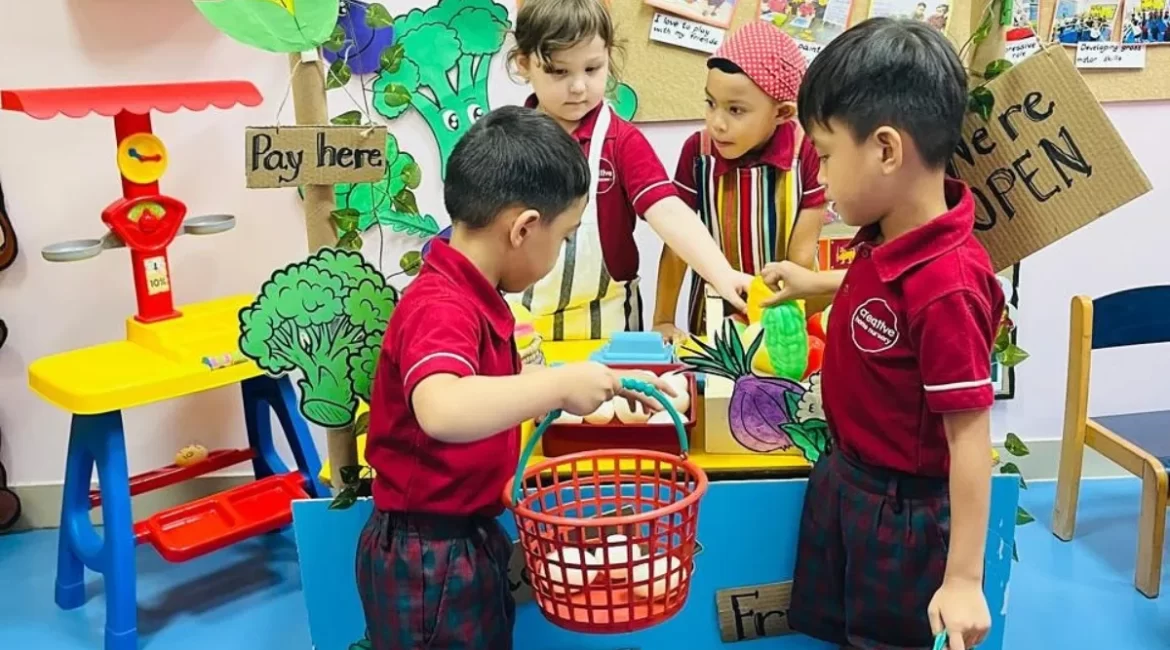
When children stack blocks into wobbly towers or pretend to run a restaurant with plastic food, they’re doing far more than just having fun. They’re learning essential skills that will shape their future success in school and beyond.
Play-based learning is an educational approach that uses play as the primary method for helping young children explore, discover, and understand the world around them. Rather than sitting at desks memorizing facts, children learn through hands-on activities that feel natural and enjoyable. This approach has gained significant traction in early childhood education settings, including many preschool and nurseries in Sharjah, as research continues to demonstrate its profound impact on child development.
For parents searching for a nursery in Sharjah that prioritizes holistic development, understanding the benefits of play-based learning can help you make informed decisions about your child’s early education. Let’s explore why this approach is so valuable for young learners.
How Play-Based Learning Supports Child Development
Cognitive Development: Building Thinking Skills Through Play
Play-based learning creates countless opportunities for children to develop critical thinking and problem-solving abilities. When a child builds a bridge with blocks only to watch it collapse, they’re learning about cause and effect, spatial relationships, and engineering principles all without formal instruction.
Through play, children develop:
- Problem-solving skills: Figuring out how to make a puzzle piece fit or why their sandcastle keeps crumbling
- Memory and concentration: Remembering rules to games or sequences in pretend play scenarios
- Language development: Expanding vocabulary as they describe their play activities and interact with peers
- Mathematical thinking: Sorting objects by color, counting toys, or dividing snacks equally
These cognitive benefits lay the foundation for academic success later in life. Children who engage in rich play experiences often show stronger reasoning skills and greater creativity when they enter formal schooling.
Social and Emotional Growth: Learning to Navigate Relationships
Perhaps one of the most valuable aspects of play-based learning is how it helps children develop social and emotional intelligence. When children play together, they practice essential life skills that will serve them throughout their lives.
During collaborative play, children learn to:
- Share resources and take turns
- Negotiate roles and rules
- Express their feelings appropriately
- Understand different perspectives
- Resolve conflicts peacefully
- Build friendships and trust
A quality preschool in Sharjah that embraces play-based learning provides supervised opportunities for children to practice these skills in a safe environment. Teachers can guide children through disagreements, helping them find solutions and understand each other’s feelings.
Play also allows children to process their emotions and experiences. Through pretend play, they can act out scenarios that might be confusing or frightening, giving them a sense of control and understanding.
Physical Development: Building Coordination and Strength
Physical play is crucial for developing both gross and fine motor skills. Running, jumping, climbing, and dancing help children build strength, coordination, and body awareness. Meanwhile, activities like drawing, threading beads, or playing with Play-Doh refine the small muscle movements needed for writing and self-care tasks.
Regular physical play also promotes:
- Healthy growth and development
- Better sleep patterns
- Improved focus and attention
- Reduced stress and anxiety
What Play-Based Learning Looks Like in Practice
Play-based learning takes many forms, and the best programs incorporate a variety of activities to support different areas of development.
- Dramatic Play: When children dress up and pretend to be doctors, teachers, or shopkeepers, they’re exploring different roles and practicing social skills. These scenarios help them understand the world around them and develop empathy.
- Construction Play: Building with blocks, magnetic tiles, or even cardboard boxes helps children understand concepts like balance, symmetry, and spatial relationships. They learn to plan, test ideas, and persevere when things don’t work the first time.
- Sensory Play: Activities involving water, sand, clay, or other materials engage children’s senses and encourage exploration. These experiences are calming and help children develop focus and concentration while also strengthening their emotional awareness and self-regulation. Through sensory play, children learn to connect their thoughts with actions all of which support deeper learning and overall development.
- Art and Craft: Creative activities allow children to express themselves, make choices, and see their ideas come to life. There’s no right or wrong way to create, which builds confidence and encourages experimentation.
- Outdoor Play: Nature provides endless opportunities for discovery. Children can observe insects, collect leaves, or simply run freely. Outdoor play is particularly important for physical development and connecting with the natural world.
Bringing Play-Based Learning Home
Parents don’t need expensive toys or elaborate setups to support play-based learning at home. Here are some practical ways to encourage meaningful play:
- Create Space for Unstructured Play: Allow time in your daily routine when your child can choose their own activities without adult direction. This freedom helps them develop independence and creativity.
- Provide Open-Ended Materials: Simple items like blocks, art supplies, dress-up clothes, and household objects (pots, wooden spoons, fabric scraps) can be used in countless ways, encouraging imagination.
- Join in the Play: Follow your child’s lead during play. Ask questions about what they’re doing, take on roles in their pretend scenarios, and show genuine interest in their ideas.
- Limit Screen Time: While some digital content can be educational, it shouldn’t replace hands-on play experiences. Prioritize activities that involve physical manipulation and social interaction.
- Connect Play to Real Life: Involve your child in everyday tasks like cooking, gardening, or organizing. These activities provide practical learning opportunities and quality time together.
- Embrace Messiness: Play can be messy, and that’s okay. Art projects, outdoor exploration, and sensory play often create chaos, but they’re worth the cleanup.
Why Play Matters for Lifelong Success
The benefits of play-based learning extend far beyond early childhood. Children who have rich play experiences develop a strong foundation for future learning. They enter formal schooling with confidence, curiosity, and the social skills needed to thrive in group settings.
These children typically show:
- Greater engagement in learning activities
- Stronger relationships with peers and teachers
- Better emotional regulation
- More creativity and flexibility in thinking
- Increased resilience when facing challenges
As parents consider options for their children’s early education, choosing a nursery in Sharjah that values play-based learning can set the stage for a lifetime of curiosity and love of learning.
At Creative Home Nursery, we recognize that play is the foundation of early childhood education. Our experienced educators create environments where children can explore, discover, and grow through meaningful play experiences that support their cognitive, social, emotional, and physical development.
Play isn’t a luxury or a break from “real” learning. It’s how young children make sense of their world, develop essential skills, and build the confidence to become lifelong learners. By honoring children’s natural way of learning through play, we give them the best possible start in life.