
Before a child learns to write their name, hold a pencil correctly, or even sit still at a table they need to move. A lot. Running, jumping, throwing, climbing, rolling around on the floor, all of this messy, energetic, seemingly chaotic play is actually serious developmental work happening in real time.
Motor skills fall into two categories: gross motor skills, which involve large muscle groups and whole-body movement, and fine motor skills, which involve smaller, more precise movements of the hands and fingers. Both are critical during the preschool years, roughly ages two to five, and both develop most effectively through active, playful engagement.
At a creative home nursery, the good news is you don’t need a gym or an expensive play centre. Some of the most effective motor skill activities require nothing more than a bit of floor space, everyday objects, and your time. Let’s get into it.
The Connection Between Physical Play and Early Development
Here’s something many parents don’t realise: physical activity and cognitive development aren’t separate things at this age. They’re deeply connected. When a child navigates an obstacle course, they’re problem-solving. When they learn to balance on one foot, they’re building concentration. When they stack blocks and knock them down, they’re developing hand-eye coordination and spatial awareness.
Research consistently shows that preschoolers who engage in regular structured and unstructured physical activity perform better in language tasks, social interactions, and early literacy readiness. Movement literally builds the brain architecture needed for learning.
This is why any quality creative nursery approach, whether at home or in a formal setting, weaves physical activity intentionally into the daily routine rather than treating it as “just play time.”
Gross Motor Skill Activities for Preschoolers
Obstacle Courses — the All-Time Classic
Set up a simple course using cushions, chairs, tunnels made from blankets, and low steps. Ask children to crawl under, jump over, balance along, and weave between objects. You can change the layout every few days to keep it fresh and challenging.
This activity builds coordination, balance, spatial awareness, and body control. It also encourages problem-solving as children figure out how to navigate each section. Keep it fun, not competitive celebrate effort, not speed.
Balloon Volleyball
Blow up a balloon and the game is on. Batting a balloon back and forth is deceptively brilliant for developing hand-eye coordination, reaction time, and bilateral coordination (using both sides of the body together). It moves slowly enough for little ones to track it, and it’s genuinely hilarious when it floats sideways.
Use a piece of string tied between two chairs as a “net” to add structure, or just keep it freeform. Either way, children are working hard physically while having a blast.
Hopping, Skipping, and Jumping Games
Simple games like hop on one foot, jump into a hula hoop, or leap between “lily pads” (paper plates on the floor) do wonders for balance, leg strength, and bilateral coordination. These skills directly support later abilities like climbing stairs confidently, participating in group sports, and even learning to ride a bike.
One variation that works brilliantly in a home nursery setting: create a color-coded jumping trail on the floor using colored tape. Call out a color and watch children leap, hop, or tiptoe their way to it. It mixes movement with early color recognition beautifully.
Ball Play — Rolling, Kicking, and Catching
Don’t underestimate the humble ball. Rolling, kicking, and eventually catching a ball engages the whole body and builds essential tracking and coordination skills. Start with large, soft balls for younger children and introduce smaller sizes as their confidence grows.
Even simple back-and-forth rolling while sitting on the floor is valuable at age two. By three and four, children can begin kicking toward a target and attempting to catch with two hands. These milestones matter enormously for physical confidence.
Fine Motor Skill Activities for Preschoolers
Playdough and Clay Work
If there’s one activity that packs the biggest fine motor punch in the smallest package, it’s playdough. Rolling, squeezing, pinching, pulling, and shaping playdough strengthens the tiny muscles in fingers and hands that children will later use for writing, drawing, and self-care tasks like buttoning shirts.
Add small tools plastic knives, rolling pins, cookie cutters and you increase the challenge and creativity further. A creative home nursery activity as simple as “make a pizza” or “create a garden” with playdough can keep a preschooler meaningfully engaged for 30 to 40 minutes.
Threading and Lacing
Give a child a lace and some large wooden beads or pasta shapes and watch the concentration on their face. Threading requires hand-eye coordination, pincer grip strength, and sustained focus all critical fine motor foundations.
You can DIY this easily: punch holes in cardboard shapes and let children “sew” them with a shoelace. These activities directly prepare children for holding pencils, using scissors, and other school-readiness skills.
Tearing, Cutting, and Sticking
Tearing paper might seem like a toddler’s destruction mission, but controlled tearing builds hand strength and bilateral coordination. As children approach age three and four, introducing child-safe scissors and simple cutting tasks along straight lines (then curves, then shapes) is a genuine developmental milestone.
Collage-making tearing, cutting, and sticking pieces together is one of those activities that hits multiple developmental targets at once while also being wildly creative. It’s a staple in any good creative nursery programme for good reason.
Building and Stacking
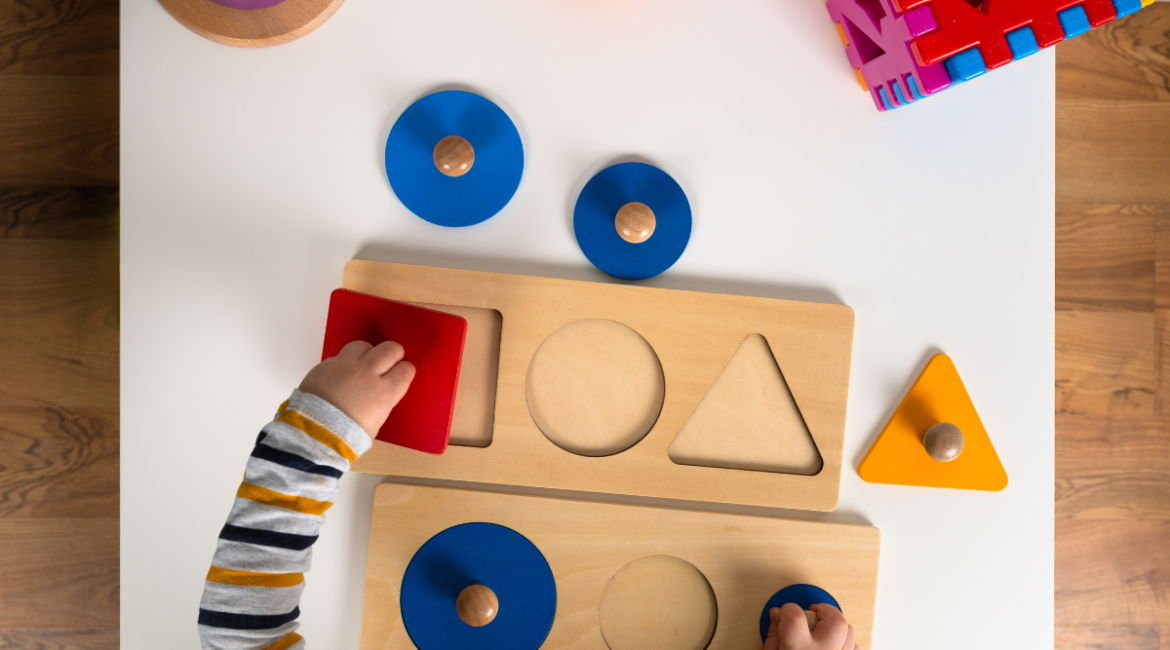
Blocks, stacking cups, LEGO Duplo — all of these require precise hand control, grip adjustment, and spatial reasoning. Encourage children to build towers as tall as possible, create enclosures for toy animals, or sort shapes and sizes. The physical act of picking up, placing, adjusting, and stacking trains the fine motor precision that underpins writing and drawing.
Outdoor Movement — Fresh Air, Fresh Connections
Whenever possible, take the activity outside. Digging in the garden, drawing with chalk on pavement, climbing on low structures, and simply running on grass all provide sensory and motor experiences that indoor spaces can’t fully replicate.
The uneven surfaces outside grass, gravel, gentle slopes naturally challenge balance and proprioception (the body’s sense of where it is in space) in ways a flat floor simply cannot. In a home nursery context, even a small garden or balcony offers invaluable outdoor movement opportunities.
Making It Routine, Not Random
The most effective approach isn’t a single special activity once a week it’s weaving varied physical activity into every single day. A morning obstacle course, a balloon game before lunch, some playdough after nap time, and an outdoor run in the late afternoon. Together, these short bursts of movement add up to comprehensive motor development over time.
A creative home nursery environment thrives when physical activity is treated as a learning priority, not a gap-filler between “real” activities. Because for preschoolers, movement is the most real learning there is.
Conclusion
Motor skills don’t develop in isolation. They grow through play, through trial and error, through a child who’s been given the space and opportunity to move their body in a hundred different ways. Your role isn’t to run a gym class it’s to create an environment where movement is joyful, regular, and richly varied.